work from life like the old masters, from photos, or from your
imaginative sketches
Feedback
get feedback from your fellow students as well as from Shane
Fine Art Painting Classes in Marietta, GA
Learn to create more impactful works of art!
Shane McDonald: Over 25 Years of Fine Art Mastery: As a professional painter based in Marietta,
GA, Shane McDonald has dedicated over two decades to the pursuit of representational drawing and painting
excellence. His artwork, ranging from intricate portraiture to expansive landscapes, is defined by a deep
understanding of light, color, and anatomical precision.
2026 In-Person Schedule
Ages 13 - Adult | up to 13 students in each class
Free Consultation About Classes
Shane wants to tailor his instruction to you. To maximize your class experience,
e-mail him two or three
images of your artwork and discuss your goals and inspirations. He’ll recommend your first project and list
the best materials for your first class.
September 28 - November 16, 2026 (Make-up classes in December)
This class will be taught in Shane's new expanded studio K. It will be available to other teachers and
workshops scheduled throughout the year. The schedule below is tentative, and some dates may be shifted.
All classes are held at studio K of the Artisan Resource Center. Current
students have priority for registration,
and public links to register, if there is availability, will be posted by Saturday, September 26.
Due to the increased load of Shane's art projects, Shane will suspend his Sunday class indefinitely.
Talented artist Hoyt Stover will be
teaching on Sundays in studio K2 instead.
MON 7pm
TUE
WED
THU 9:30am
FRI 9:30am
SAT
SUN
SEP 28 ①
OCT 1 ①
OCT 2 ①
OCT 5 ②
OCT 8 ②
OCT 9 ②
OCT 12 Open Studio: $15
OCT 15 Open Studio: $15
OCT 16 Open Studio: $15
OCT 19 ③
OCT 22 ③
OCT 23 ③
OCT 26 ④
OCT 29 ④
OCT 30 ④
No Class NOV 2
No Class NOV 5
No Class NOV 6
NOV 9 ⑤
NOV 12 ⑥
NOV 13 ⑥
NOV 16 ⑥
No Class NOV 19
OPEN HOUSE No Classes NOV 20-21-22
NOV 23 ⑦
No Class NOV 26
No Class NOV 27
No Class NOV 30
DEC 3 ⑦
DEC 4 ⑦
* This schedule is tentative. It may be updated before October. = Open Studio Session
(limited instruction), extra $15 =
Make-up
Class or Optional $40 Drop-in Class
(if availability) = Open
House Hours (all welcome): 6 p.m. - 10 p.m. Friday, 11 a.m. - 6 p.m. Saturday, 1 p.m. - 5 p.m.
Sunday
January - March (Dates to be announced)
All of these classes are held at studio K of the Artisan Resource Center.
Tailored Mentorship: Shane provides individual guidance, helping students work at their
own
pace on unique projects.
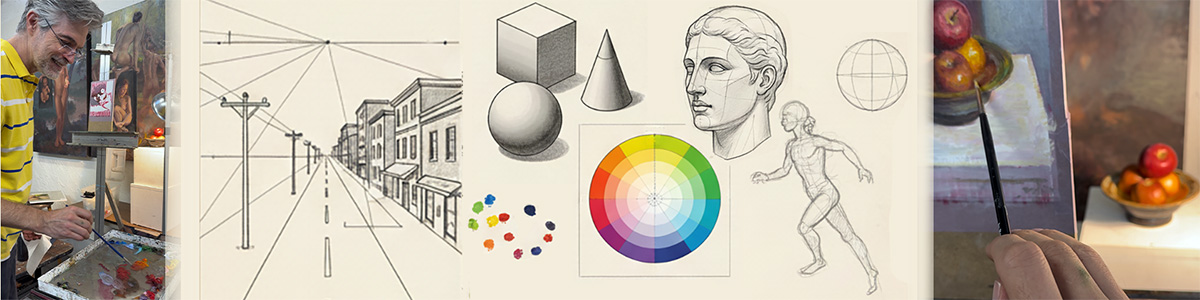
Technical Expertise: His curriculum covers essential fundamentals, including linear
perspective, color harmony, and the "illusion of space" in 2D art.
A Painter’s Perspective: Beyond the classroom, Shane is an active figure in the local
art
community, hosting weekly figure drawing sessions with live models.
Class Details
Students are expected to bring their own ideas, sketches, or photo references, and art materials to each
weekly class meeting. It’s encouraged to work at an
easel vertically or semi-vertically (for watercolorists).
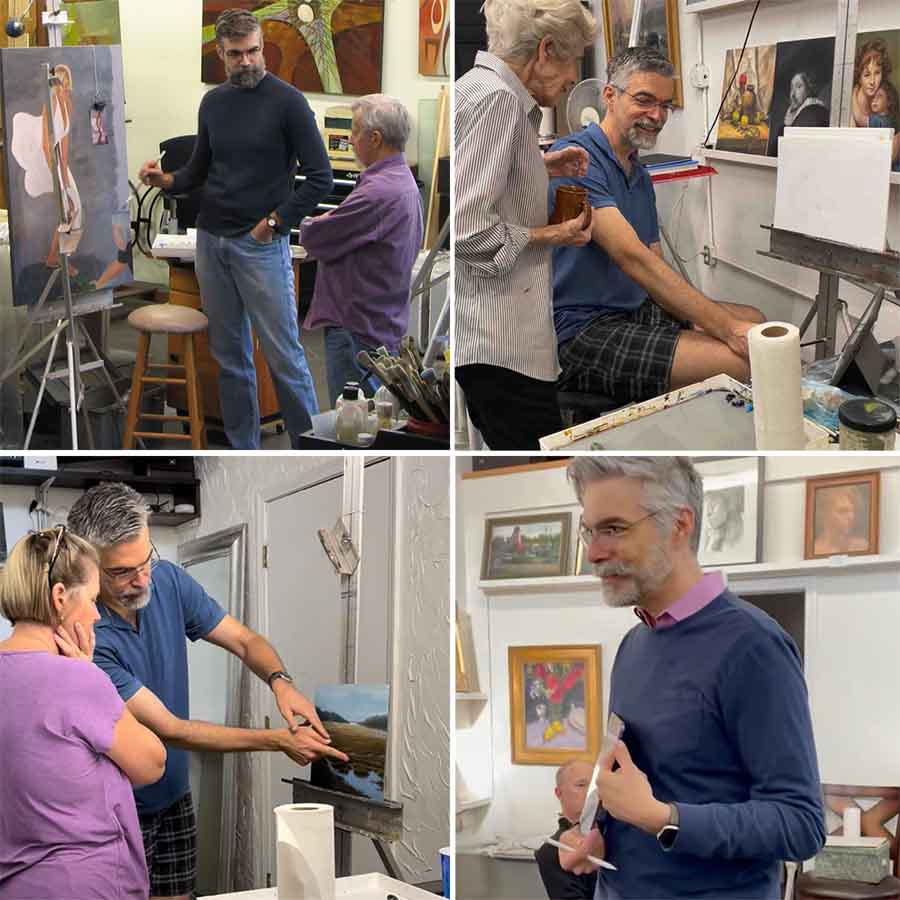
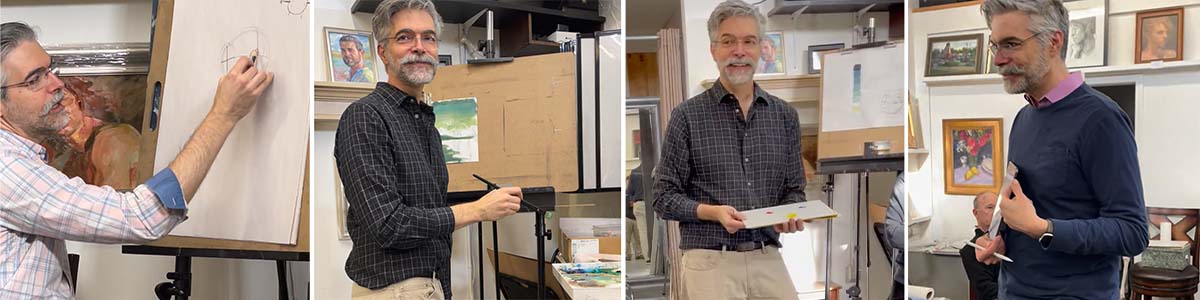
Periodically, 30-40 minutes into the first hour, Shane demonstrates a technique or concept
for the class to follow. He explains and demonstrates exercises enabling each student’s
personal style to shine through. Topics vary based on class interests.
Topics covered through periodic class demonstrations and group exercises:
Learn to see abstractly through gesture sketches
Types of composition and creating movement
Importance of composing thumbnail sketches
Linear perspective (1- and 2-point)
Values of light and dark on forms
Color wheel and color mixing
Merging/Grouping shapes for greater impact
Color schemes - make studies with limited palettes
Apply color harmony
Drawing features of the human head
Drawing features of the human body
Composing from more than one reference
After each exercise, Shane individually critiques students’ project progress, providing recommendations,
encouraging comments, and answering questions. He sketches ideas for students struggling to visualize
artwork solutions and demonstrates techniques on their work with permission.
Shane’s classes are for students with some art instruction in drawing or painting, emphasizing perceptive
drawing skills for those seeking to build observational techniques.
Contact Shane McDonald with questions about the class or to schedule a free consultation:
Start with the materials you own based on Shane’s recommendations from your email consultation. He’ll
provide further instructions based on your project needs. Most of Shane’s students use materials on this general list. For a brief overview, tap below:
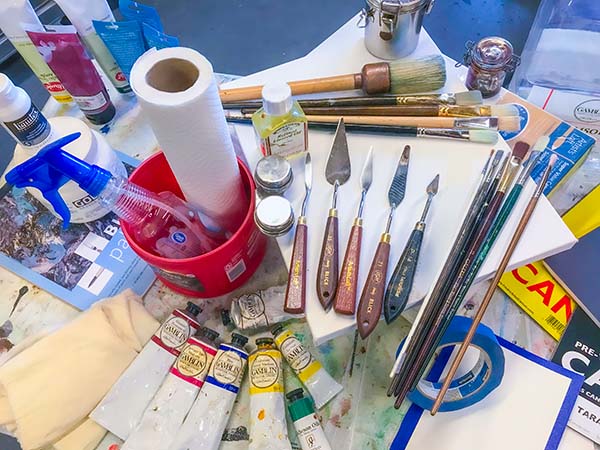
This is just a sample of the art materials Shane McDonald
uses in his own painting projects. Shane recommends Emailing a description of your goals before
purchasing art supplies. Why buy more than you need?
PROS: dries slower, more conducive for subtle details, easy to control in small amounts, easy
to blend, suitable for small and large paintings
CONS: Frustrating without instruction, more expensive materials, mineral spirits can cause
allergic reactions
Choosing Acrylics?
PROS: dries faster than oils for more immediate results and faster changes, ideal for working
large, easy clean-up with soap and water, allows for liberal paint application and easier
experimentation
CONS: the pigment dries noticeably darker, and smooth blending is difficult
Shane encourages students to paint standing up to avoid getting too close to the canvas and bogging down
on insignificant details. Class easels are provided for up to 12 students.
Watercolors
Shane also works with watercolor and gouache, preferring them for their compact and lightweight
supplies, and the media’s suitability for studies and visualizing ideas. Watercolor pigments are bound
with gum arabic, allowing reconstitution and manipulation with water. It quickly teaches color mixing
and transparency/opacity concepts. Watercolors can be a natural and economical transition to oil
painting for students accustomed to pencil drawing.
Pastels
Please see the drawing tab to learn about pastels. Shane frequently uses them in his portraits,
appealing to him for their immediacy.
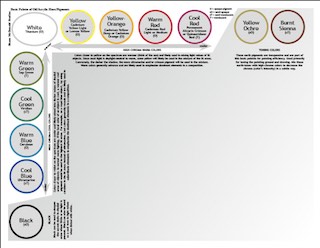
Paint Tube Pigments
Oil, Acrylic and Watercolor Pigments (or their color
equivalents) listed below are essential for limited-palette
paintings in most lighting situations. Students are welcome to purchase the often
less-expensive "hue" versions of colors. This "palette" of colors represent a warm and cool
version of the primary colors plus some secondary
colors and useful neutrals. Other colors can be bought in
miniature tubes or later as needed.
Titanium White (large tube)
Cadmium Yellow Light (warm)
Cadmium Red Light (warm)
Permanent Alizarin Crimson [or Alizarine hue] (a relatively cool red)
Ultramarine Blue (cool)
Cerulean Blue (relatively warm)
Viridian Green [optional] (a relatively cool green)
Permanent Sap Green [or Sap Green hue] (a relatively warm green)
Palette
OILS:
CHOOSE ONE:
A 12 X 16 inch sheet of glass purchased at a
home improvement/hardware store fits well within a
"Mastersons" plastic palette holder
(protects the wet paint during transport). The edges
of the glass should be taped and backed with
heavy-duty masking tape to the edges of an
equally-sized gray or neutral-colored mat board. The
tints and shades of colors are usually easier to see
on when not on white or black. The mat board also
strengthens the glass to prevent breakage.
Coated disposable paper palette (available at art
supply stores — preferred without a thumb hole)
ACRYLICS:
CHOOSE ONE:
"Mastersons" "Stay-wet" palette sponge and water-soaked palette paper for use
in the "Mastersons" Palette works great for most students. The colors dry much slower (in
a good way) when using this palette. To learn how to prepare this palette, watch about 2 minutes of
this video, follow
the instructions, and you'll be set for weeks!
A flat plastic, wood, or coated paper palette with a 12" X 16" area works fine.
Solvents and Painting Mediums
ACRYLICS: It's not necessary to bring any water or acrylic mediums if using acrylics. Shane
will supply a water container for you. He may recommend the purchase of additional acrylic painting
mediums for some rare projects.
OILS: Solvent and a container for it will be necessary.
Mineral Spirits (solvent for oil painting used for thinning and cleaning) CHOOSE
ONE:
Gamsol by Gamblin (has no odor at all)
No-Od by Utrect (may have very slight odor)
Turpenoid by Weber (may have very slight odor)
Container for Solvent CHOOSE ONE:
metal "brush-washing" jar
small pickle jar with sealable lid
if working detailed and smaller than 11 x 14, a glass baby-food jar works fine
Painting Medium
Shane will supply painting medium on the first day you need it, so don't by this until you see
Shane about your options.
OILS: a mixture of 1 part stand linseed oil, 1 part refined linseed oil, and 2 parts turpentine or
Gamsol (for use with oils only).
ACRYLICS: a fine-misting spray bottle and acrylic gel medium. Shane will supply the acrylic gel
medium on the first day you need it, so don't by this until you see Shane about your options.
Brushes and Painting Tools
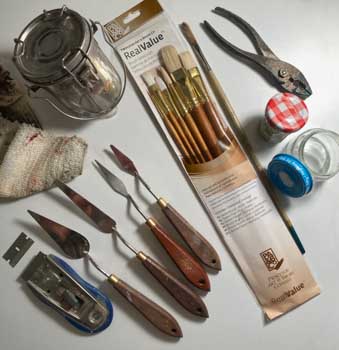
A sampling of the palette knives, solvent containers, and
palette scraper tools Shane prefers in his own oil and acrylic painting process.
rags (rather than paper towels)
Diamond-head Palette Knife (pick sizes for scraping the
palette of paint daubs and painting large and small areas). Please see photo above for an image of
the type you need.
Brushes (Shane prefers long-bristled filberts and flats
for oils and acrylics.) A selection of 4-5 Sizes should
range from about 3/32 inch to about 1 inch (or larger if you
work large). Some brushes should be soft with thin-fibered bristles (for smooth areas and details),
and others should be more stiff with thick-fibered bristles. (Brand new painters can use Shane's
brushes at the first class to see the range needed before purchasing.)
A #0 round pointed round brush works well for finer
details, but this is likely not needed at a beginner's first class.
Painting Substrates (surface on which you paint)
The painting substrate is best chosen by your specific goals in the class. Please e-mail Shane before
purchasing new painting substrates such as stretched canvas.
canvas pads or thick paper primed with acrylic gesso
canvas boards or primed painting panels
loose pre-primed canvas (that can be taped to boards)
(stretched canvas/linen sizes 12" X 9" and larger for both oils and acrylics)
Tote Container for Transport of Materials
Make it easy on yourself by keeping your supplies together. A rolling travel bag or a
tackle box can hold paints, brushes, palette knife, rags, a jar for mineral spirits,
painting medium, and other small tools.
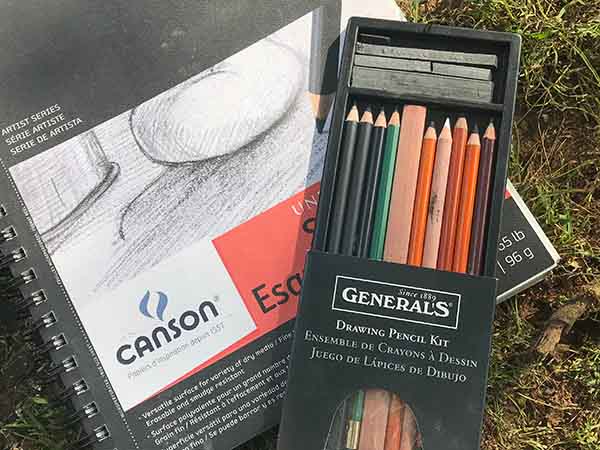
This is just a sample of the art materials Shane McDonald
uses in his own drawing projects. Shane recommends Emailing a description of your goals before
purchasing art supplies. Why buy more than you need?
Although most students in Shane's classes paint, he believes
that painting is an extension of drawing—only in color.
Students who struggle with capturing the accurate representation
of objects are encouraged to use traditional drawing media as
much as possible. He encourages students to develop a habit of creating thumbnail sketches or color
studies of their designs before proceeding on their larger drawing or painting projects. This serves as
a tool to bring the elements of the design together at once, allowing potential hurdles to be discovered
and solved before or while working on its relative project.
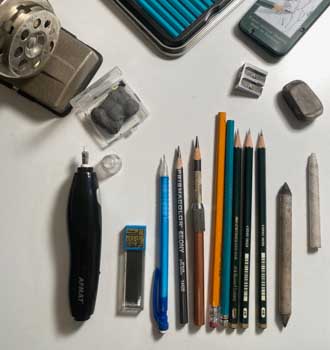
Graphite Pencils
Samples of graphite pencils and other tools for drawing
with this basic medium
Graphite is the lead material used in our #2 yellow pencils used in elementary school. It's a good
choice for quick sketching of ideas and thumbnail designs in our sketchbook. Shane prefers using this
media on small projects because it tends not to spread over large paper surfaces as quickly. It can be
used for highly detailed drawings because the pencil point can sharpened well. Shane prefers use of a
kneaded eraser with pencil, and he recommends a range of weights if creating a tonal value drawing.
Blending tools such as stumps/tortillons can be used for blending pencil strokes. Powdered graphite
and slightly-pigmented sticks can also be purchased for use on larger works. Graphite is best used on
smooth white papers because it has a sheen that can reduce contrast against colored papers.
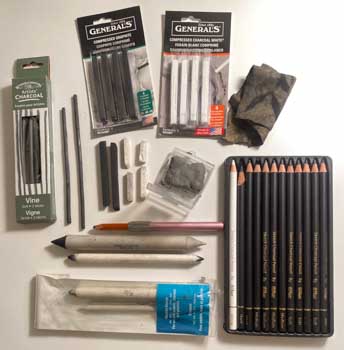
Charcoals
Samples of charcoal sticks, pencils, kneaded eraser,
stumps, and other tools for drawing with this basic tonal drawing medium
Charcoals are Shane's black/white medium of choice. It's faster because the particles spread easily
across the paper with many different types of tools and techniques. It's a great medium for grayscale
(black/white) tonal drawings.
Graphite Pencil (weights/hardnesses: Ebony or 8B, 2B, HB, and 4H)
Kneaded Eraser Medium Size (not pink or gum eraser)
Range of different weights charcoal pencils (hard, medium, soft, extra soft)
Pack of different sized paper stumps (tortillons)
Vine charcoal sticks
Charcoal sticks
18 or 24-inch straight edge/ruler
Drawing surface: Start with a sketch book only. Bristol and/or charcoal pads can be
purchased later.
Sketch Book (choose size 9 x 12 to 14 x 17 inches and between) with white paper
Bristol Pad (choose size 11 x 14 to 18 x 24 inches and between) with white paper
Charcoal Pad (choose size 12 x 16 to 18 x 24 inches and between) with toned gray or brownish
paper
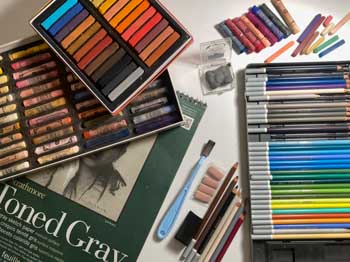
Soft Pastels
Samples of charcoal sticks, pencils, kneaded eraser,
stumps, and other tools for drawing with this basic tonal drawing medium
Soft pastels (sometimes referred to as chalk pastels) are a dry pigment medium formed into a crayon
or stick. Each brand has a slight variation of softness and pigment variation, but they are usually
interchangeable. They are applied in layers on paper that have a "tooth" (rougher surface) in the
paper fibers or a sandy grit applied to the paper surface. Blending tools can be used to mix colors
from various layers of color on the drawing/painting surface.
Want to learn about mixing colors? Pastels are a great way to learn about color
mixing for those transitioning from monochromatic drawing media to color media—including paint!
Pastellists
should bring a complete set of at least 24 colors in medium-to-soft (non-oil-based) pastels. Some
pastel
pencils are also recommended. Contact Shane
for more information on purchasing and using pastels.
Tote Container for Transport of Materials
Make it easy on yourself by keeping your supplies together. A small tackle box can
hold
pencils, graphite or charcoal sticks, stumps and tortillons, erasers, white and sepia conté, an ink
stylus, pen nibs, perhaps a short straight-edge, and a sharpener. If you like to work large, it may be
a
good idea to keep your large pads of paper in a portfolio case. The other supplies
may
fit well in a zippered pouch.
Shane can help you achieve your desired effect in painting through references.
Use your own photos to inspire your projects. These references help Shane understand your
vision. Shane teaches how to interpret forms, object scale, and light’s impact on tonal values and
colors.
Reproductions of the works of the old masters: While Shane emphasizes the importance of
respecting
copyright of images by others in his classes, he does acknowledge that a great way to learn technique
is by copying and studying masterful artworks of the old masters.
Magazine pictures: Since images are plentiful in the pages of Magazines, looking at them to
understand how things appear in different positions and lighting situations can help with their
depiction in drawings and paintings. Clippings can be mixed and matched and applied as collage in some
final projects as well. Shane encourages experimentation in his classes as there is no limit to the
image-making possibilities.
Studies of ideas on paper: Your own sketches and doodles can offer plenty of inspiration for
larger paintings and drawings. Why not try letting your imagination go wild? Use the elements and
principles of design to bring exciting compositions to fruition.
Still-life objects: If space permits, you may bring your own simple objects to paint in a quick
still-life setup (which must be taken down at the end of class) or you may use Shane's collection of
still-life objects. Please be prepared to light your setup on your own. You may take digital reference
images of the still-life at the end of class.
Digital Media: Shane has some small easels that will hold digital tablets and laptop
computers. More and more students use electronics to display their reference images.
Digital Reference Apps and Tools: Shane often uses human posing apps such as Art Pose,
Art Model, and Handy, to aid in the understanding of human form when seen in different
positions and lighting. These apps allow one to manipulate body positions in a virtual space. Shane
also uses an iPad and the iPad app, Procreate, to make digital studies. It can also be used as
an aide to quickly correct rendering problems in complex representational artwork. Notanizer is
a great app to help simplify tonal values in a digital photograph.
Testimonials
From the very first class, it was clear that I had found a rare and special teacher. Shane is a
truly
talented artist whose talent shines through his paintings and teaching style! His portraiture
captures
not
just a likeness, but the very soul of his subjects. He has equal proficiency in landscape and
figurative
art.
Sadeka S.
Shane prepared my son for more challenging things in high
school. I believe that young people who are serious about
developing their artistic talents would benefit from receiving
instruction from Shane.
Kathleen M.
Shane is one of the most knowledgeable fine art teachers I
have ever known! His ability to share his knowledge in a
formative way helped me to hone in on each aspect of a
specific skill allowing me to complete one segment of learning
at a time. Whether it be drawing or painting, he allowed
plenty of time to exercise my newly found artistic expression
thus allowing the freedom be able to take the knowledge home
and practice.
Margaret H.
Book your attendance
Please allow the Setmore booking page to load and the date to refresh.
Use the "Book" button to register.
Select "Create a Profile" if you plan to register for more than one service with Shane over time.
Otherwise, select "Continue as Guest."
Enter your contact info (Name and e-mail are required) and "Continue."
Pay with Credit Card, CashApp, ApplePay, GooglePay - OR - Tap/click "Pay in person." At the meeting you
can pay via
cash, check, Venmo, PayPal, or Zelle. Ask Shane to take your exact-change cash or check payment.
Tap/Click the "Confirm" or "Pay and Confirm" button to reveal a confirmation screen.
Please note that the booking is for a series of meeting dates
and not just one meeting.
 Shane wants to tailor his instruction to you. To maximize your class experience,
e-mail him two or three
images of your artwork and discuss your goals and inspirations. He’ll recommend your first project and list
the best materials for your first class.
Shane wants to tailor his instruction to you. To maximize your class experience,
e-mail him two or three
images of your artwork and discuss your goals and inspirations. He’ll recommend your first project and list
the best materials for your first class.